
Best Level Switch For Cement, Flour, Plastic Granules And Bulk Solids
Cement, flour, plastic granules and bulk solids have very different density, dust, flowability and buildup characteristics. The best level switch should be selected according to the material condition, silo structure, detection purpose and long-term reliability requirements.
Get Quote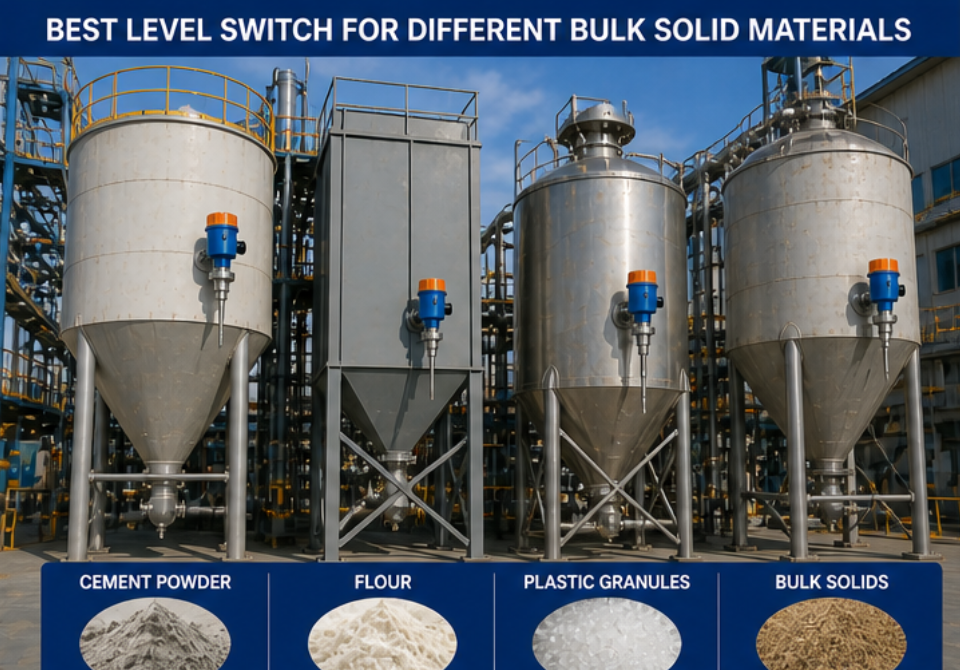
Why One Level Switch Cannot Fit All Bulk Solid Materials
Bulk solid level detection is more complex than simple liquid level detection. Cement is dusty and abrasive. Flour is light and may create dust or buildup. Plastic granules usually flow well but may have larger particle size. Other bulk solids may be heavy, sticky, humid or difficult to discharge.
If buyers select a level switch only by price or appearance, the sensor may create false alarms, fail to trigger, wear too quickly or require frequent maintenance. Correct selection starts from understanding the material.
1. Best Level Switch For Cement Powder
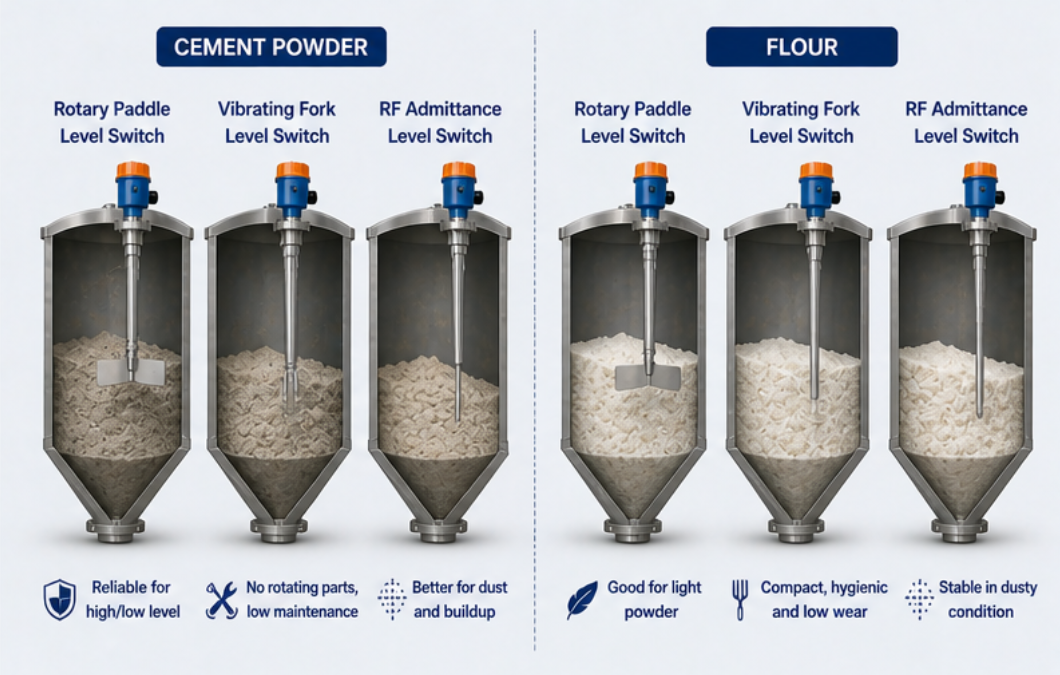
Cement powder is fine, dusty and abrasive. During silo filling, cement dust can cover the sensor surface and create unstable signals. In many cement silo projects, rotary paddle level switches are used for basic high-level and low-level alarms because they are economical and widely accepted.
For cement silos with heavy dust, buildup or repeated false alarms, RF admittance level switches may provide better stability. Buyers should also pay attention to sealing, installation position and protection from direct filling impact.
2. Best Level Switch For Flour And Food Powders
Flour and food powders are usually light, dusty and sometimes sticky when moisture is present. The level switch should be sensitive enough for low-density powder and should be easy to clean in food-related processing environments.
Rotary paddle level switches can be used for dry and free-flowing flour. Vibrating fork level switches are suitable for compact hoppers and low-wear applications. If flour buildup or coating causes false signals, RF admittance level switches should be considered.
3. Best Level Switch For Plastic Granules
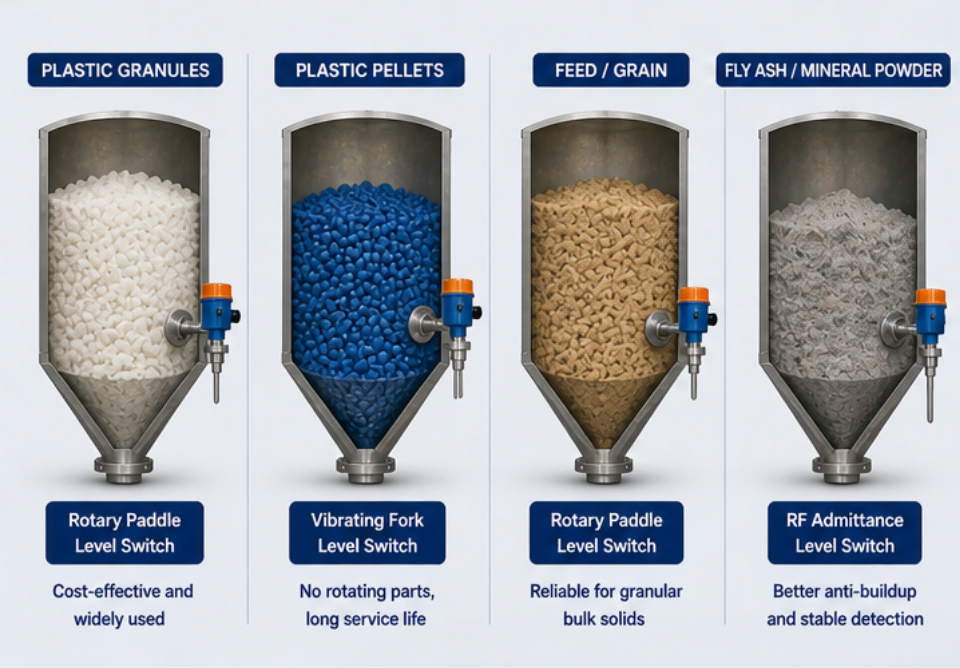
Plastic granules usually have better flowability than fine powder, but particle size and silo structure still affect detection. For many plastic pellet hoppers and storage bins, rotary paddle level switches are a practical and cost-effective choice.
Vibrating fork level switches can also be used when compact installation, no rotating paddle or lower mechanical wear is preferred. Buyers should confirm particle size, material flow direction, installation space and whether the granules may impact the sensor during filling.
4. Best Level Switch For General Bulk Solids
Bulk solids may include feed, lime powder, fly ash, mineral powder, grain, pellets and chemical powder. The best level switch depends on whether the material is light, heavy, sticky, dusty, abrasive or free-flowing.
For dry and normal bulk solids, rotary paddle and vibrating fork switches are common choices. For sticky, dusty or coating materials, RF admittance level switches can help reduce false alarms. For clean granular materials, a simple and reliable mechanical solution may be enough.
Recommended Level Switch By Material Type
| Material | Common Problems | Recommended Level Switch |
|---|---|---|
| Cement Powder | Dust, abrasion, buildup, false alarms | Rotary paddle / RF admittance |
| Flour | Light density, dust, moisture buildup | Rotary paddle / vibrating fork / RF admittance |
| Plastic Granules | Particle size, material impact, hopper space | Rotary paddle / vibrating fork |
| Fly Ash | Fine dust, buildup, difficult flow | RF admittance / rotary paddle |
| Feed And Grain | Granular flow, bridging, storage variation | Rotary paddle / vibrating fork |
| Chemical Powder | Corrosion, dust, coating, safety requirement | RF admittance / capacitance / customized model |
Quick Selection Guide
For general dry powder silos: choose rotary paddle level switch.
For compact hoppers or low-wear applications: choose vibrating fork level switch.
For dusty, sticky or buildup-prone materials: choose RF admittance level switch.
For plastic granules and pellets: rotary paddle or vibrating fork is usually practical.
For food powders: consider sensitivity, hygiene and easy cleaning.
For cement and fly ash: pay attention to sealing, dust and installation position.
What Buyers Should Provide Before Quotation
To select the best level switch, buyers should provide material name, bulk density, particle size, dust level, humidity, silo or hopper size, installation position, high-level or low-level detection purpose, power supply, output signal and process connection.
If the material has buildup, corrosion, explosion-proof or high-temperature requirements, these details should be confirmed before ordering.
Final Recommendation
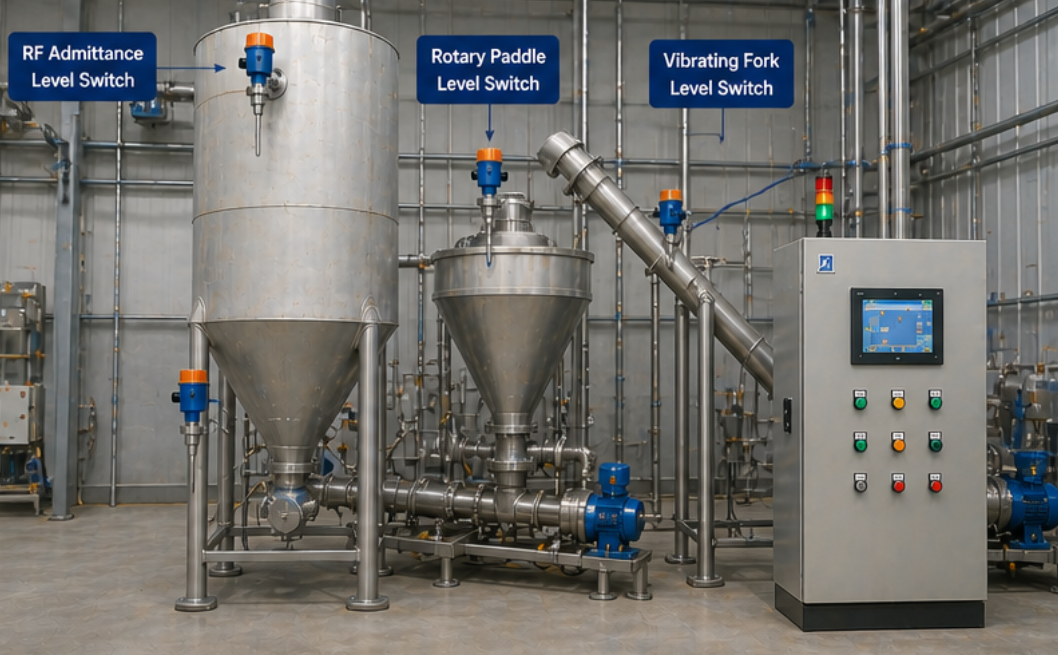
There is no single best level switch for all cement, flour, plastic granules and bulk solids. Rotary paddle level switches are practical for many dry bulk solid applications. Vibrating fork switches are suitable for compact and low-wear applications. RF admittance switches are better for dusty, sticky and buildup-prone materials.
Shao Level provides rotary paddle level switches, vibrating fork level switches, RF admittance level switches, capacitance level switches and other industrial level measurement products for silos, hoppers, tanks and automation systems.
Need Help Choosing A Level Switch For Bulk Solids?
Send us your material type, silo size, installation position and working conditions. Shao Level can help recommend a suitable level switch solution.
Contact Us / Get Quote